
Crystallising...
Learn with Me, Writing with AI
SEO, AEO, GEO: what's the difference for copywriters
Oct 19, 2026
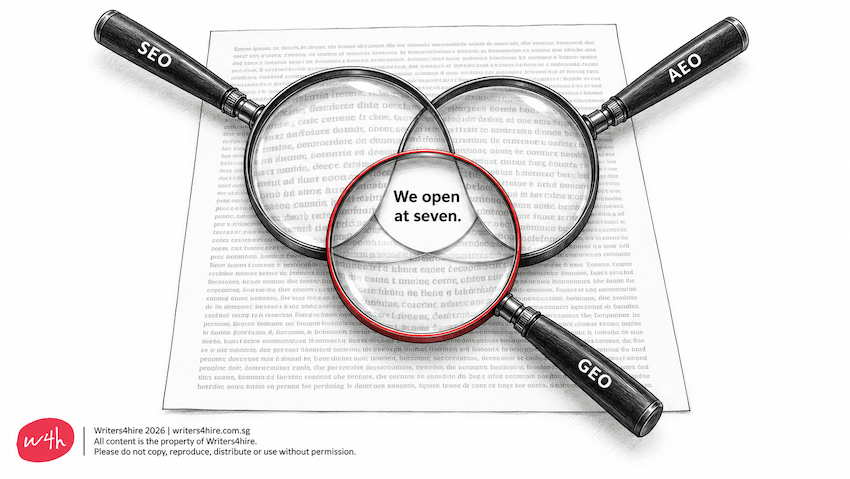
Every time someone looks something up, there are three ways your website, blog or article can reach them.
Search engine optimisation (SEO) helps your page turn up in Google’s list of results. Answer engine optimisation (AEO) makes your page the one answer that appears at the top. Generative engine optimisation (GEO) is the newest. When someone asks ChatGPT or Claude for advice, GEO helps your content be part of the answer, using facts the tool found on your website.
The good news is, all three reward what good writers already do. Get to the point early, use the words your reader would use and give them facts worth passing on.
I saw how much search has changed last week, shopping online for my dear hubby’s birthday.
As usual, the gift had to meet three criteria. It had to be useful, because he’s practical like that. It had to be 10% new, different enough to surprise and delight him yet familiar enough that he would use it. And it had to be sensibly priced, because he will ask how much it cost and I don’t want to hear that I spent too much until his next birthday. The man values value.
He likes the really old aftershaves: Tabac, Old Spice, Bravas. A year ago, I would have Googled “best vintage aftershave brand” and struggled through ten different top-10 lists in ten different tabs.
This time, I handed the job to Claude, my personal shopper, travel agent and all-round awesome research assistant. I’ve added Claude to my Chrome browser so it can read pages and click through websites for me. (A word of caution if you want to try it: Claude in Chrome is still new and Anthropic advises care on sensitive sites like banking and payment pages. In other words, use it wisely.)
A few seconds after I briefed it, Claude came back with a short list, a reason why hubby would love each one and a recommendation at the end. Proraso’s sandalwood and shea butter aftershave, from an Italian brand born in 1948, at S$29.90.
Something practical the hubs will use, check. 10% new, check. Great value, check.
I had never heard of Proraso and I never read a word anyone had written about it. Claude read it for me and decided it was worth passing on. That is the shift writers now have to write for.
Why writers need to know the difference
For most of my career, the brief has said “make it SEO-friendly”. Now clients ask whether their website will turn up when people ask ChatGPT or Claude.
They have good reason to ask. More than six in ten Singaporeans surveyed by the Institute of Policy Studies use AI chatbots, and about eight in ten of them use chatbots to look for information, reviews or recommendations.1
Even on Google, fewer people click through to websites. When an AI summary sits at the top of the results, clicks roughly halve, from about 15% of searches to 8%.2
SEO helps readers find your page
Search engine optimisation gets your page to show up as near the top as possible when someone searches.
For copywriters, this has meant knowing the keywords people actually type and working them into titles, paragraphs, meta descriptions and alt text. Done clumsily, it leaves sentences that read awkwardly. Try squeezing “best affordable aftershave Singapore” into a perfectly good paragraph.
AEO answers the question
Answer engine optimisation makes your content the direct answer to what someone is asking.
For copywriters, this means answering the question first. No more warming up with a little context and background, then making your point in paragraph three. The answer engine might not get that far and, to be fair, neither will most readers.
If someone asks, “How long does aftershave last once it’s opened?”, your first line should tell them. It shouldn’t start with your company’s commitment to quality.
The same goes for headings. A heading that asks the reader’s real question helps both the reader and the answer engine. A heading like “Is your aftershave holding you back?” doesn’t help in search, because nobody types that. A writer might still use it to tease a human reader into reading on.
There is always room for your personality. Just don’t make people work to find out what you are saying. Once the reader has their answer, by all means bring your whole sunny personality to keep them reading.
GEO gives AI something useful to include
Generative engine optimisation gets your content or business included, and ideally quoted, when ChatGPT, Gemini, Perplexity or Claude put an answer together.
The term comes from a 2023 paper by researchers from Princeton and IIT Delhi.3 They rewrote web pages in different ways to see which versions the AI picked up more. Adding quotations, statistics and sources helped most. Keyword stuffing did worse than leaving the page alone.
It makes sense when you think about it. AI tools look for something they can use. “A leading provider of innovative solutions” gives neither machines nor people anything to work with.
Somewhere out there, someone wrote something useful about Proraso aftershave. That is probably why it made my Claude shortlist.
Say you run a bakery. Instead of sounding like every other bakery, write something an AI tool can repeat when someone asks.
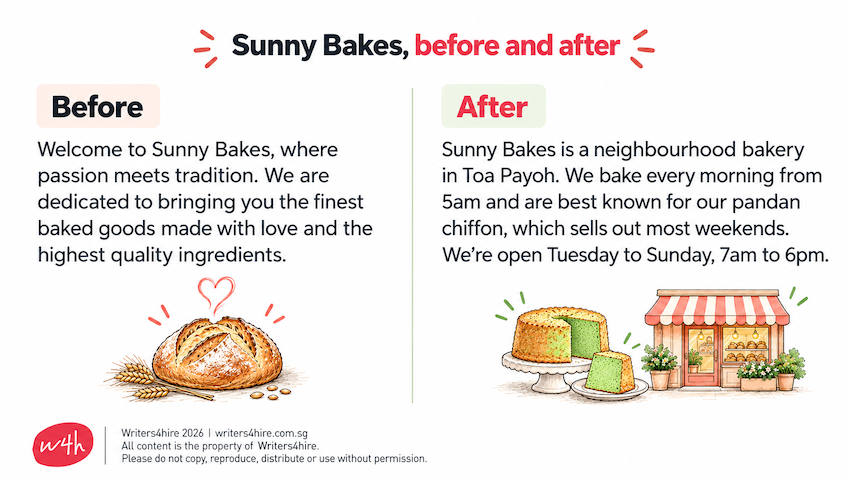
The After version answers a real search, such as “where to get pandan chiffon in Toa Payoh”. It gives the AI tool useful facts and it still sounds like a warm and wise person who runs a bakery.
What stays the same
A lot of the advice on GEO comes from companies selling tools to track it, so I’d take the bolder promises with a pinch of salt. Only the AI companies know exactly how their models choose.
What I can see is that SEO, AEO and GEO reward the same habits.
- Your first lines should answer the question the page is about.
- For your headline and headings, use the words your reader would type, such as “pandan chiffon in Toa Payoh”, not “artisanal bakes”.
- Swap empty words like “leading”, “trusted” and “innovative” for a fact that is useful to your reader.
- Read what you wrote aloud. If it doesn’t sound like a person talking, rewrite it.
As for the aftershave, it’s caught in a delivery delay. Hmmpft, not sure if that’s a human or a machine’s fault. Either way, if hubby loves it, I’ll take the credit. If he doesn’t, I’m blaming Claude!
Check out more of our Learn with Me series. And if you have a page you’d like us to look at, drop me a line.
Sources
- Institute of Policy Studies, NUS. Survey of 3,713 Singaporeans aged 21 and above, fieldwork October–November 2025, reported January 2026.
- Pew Research Center (July 2025). Google users are less likely to click on links when an AI summary appears in the results. Reported by SISTRIX.
- Aggarwal, P., Murahari, V., Rajpurohit, T., Kalyan, A., Narasimhan, K. and Deshpande, A. GEO: Generative Engine Optimization.


