
Crystallising...
Learn with Me, Writing with AI
AI bots now decide if your content is worth recommending.
Oct 26, 2026
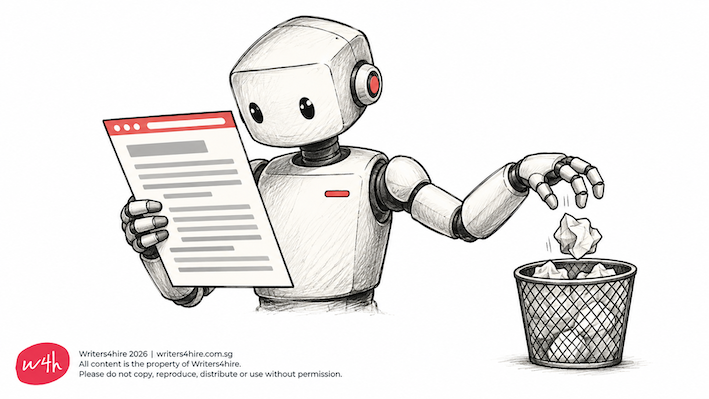
Hi! I hope you are human. Only 47% of web traffic is.
More than 53% of all web traffic in 2025 came from bots, up from 51% from 2024, according to the security company Imperva.1
Most of these bots aren’t interested in reading anything. They are busy looking for security weaknesses, copying content in bulk or trying to break into websites.
But some of them do read our pages, and they matter to writers.
There are two kinds, and they do very different jobs
Search bots read your page so they can list it in search results. Someone searches, sees your link and clicks through. They read your words, in your order and in your voice.
AI bots read your page so they can answer someone’s question for them. The person gets a summary, often without ever visiting your page. Your words are shortened, reworded and sometimes mixed with a competitor’s.
Search engines still matter. But being found is no longer enough. AI bots now tell your story for you, so they need to understand it well enough to tell it correctly.
Search bots take their time
When I was setting up this blog earlier this year, Adrian, my website go-to person at Flava Design, gave me one piece of advice.
“Put your page up as soon as possible, even if your articles are still work in progress.”
“Huh?” I didn’t want anyone reading my drafts!
“Search engines take time,” he explained.
Before a new page can appear in Google search results, Google needs to discover it. It will send a crawler to read it and decide whether to list it. This can take a few days to a few weeks.2
Of course, it’s not just Google these days.
AI companies read an enormous amount of content from websites, but send very few people back to those sites.
Cloudflare’s data shows that Anthropic’s bots read hundreds of web pages for every one person Claude sends back to a website3. Google is heading the same way. When an AI summary appears at the top of the results, only about 1% of people click a link inside it.4
That’s a lot of reading by machines and very little traffic that goes back to the source website. What’s more, our content may reach people without them ever visiting our websites.
Writing for the AI bot
We are still writing for the person. But, increasingly, there is a AI bot between us and our readers.
The AI bot doesn’t care how charming your opening is. If it can’t find the answer to the searcher’s question clearly on your page, it will take the answer from someone else’s.
That’s why I think the best advice for writing in the age of AI is surprisingly familiar.
Be clear. Be specific. And give people something useful.
The person at the other end still decides whether to trust you or buy from you.
Three things to check this week
- Find out whether AI tools can read your website. Your website may be blocking some AI crawlers without you knowing. Cloudflare, one of the biggest website networks, now lets website owners choose which AI crawlers can visit their sites, and blocks them by default for new sites.5 Some crawlers collect material for training. Others help AI assistants find information for their answers. You may have good reason to block one and allow another. Ask your website person to check the settings and explain what they mean for your site.
- Tell Google when you publish something new. You don’t have to wait for Google to find your new page. Google Search Console lets you request indexing. It doesn’t guarantee that your page will appear in the search results, but you can give Google a nudge2.
- Ask an AI assistant about your own company. Type your company name into ChatGPT, Claude or Gemini and see what comes back. If it’s thin, out of date or wrong, start by checking what your website says. You can’t control every AI answer, but you can give these systems better information to work with.
Thank you for reading and I hope you found this useful. Human to human, I really appreciate it.
If you missed it, my last piece explains SEO, AEO and GEO in plain terms: SEO, AEO, GEO and the writer who just wants to write.
Sources
-
- Imperva (April 2026). Bad Bot Report 2026: Bots in the Agentic Age.
- Google Search Central, Ask Google to recrawl your URLs.
- Cloudflare Radar, AI Insights: crawl-to-refer ratio (live data, checked October 2026)
- Pew Research Center (July 2025), as reported by SISTRIX
- Cloudflare press release, Cloudflare just changed how AI crawlers scrape the internet-at-large (1 July 2025)


