
Crystallising...
Writing with AI
Before you sign off your annual report, run an AI audit
By Crystal Song
Sep 7, 2026
We have been working with LLM-assisted content on annual reports for a few cycles now. By the time material reaches us from clients, it has often passed through more departments than a late-night trip to Mustafa. And each contributor uses AI in their own way.
Used well, AI takes the slow, repetitive jobs off the team’s hands. It can turn a pile of interview recordings into usable notes or pull together a first draft of the corporate profile from last year’s approved text.
Even though it pulls from given content, it can still get the material wrong. Our article, Why AI hallucinations are getting harder to catch, explains why.
Every fact needs to match something the company can point to, quotes need to be the approved and accurate ones and the voice needs to be consistent with the brand.
Not every team has caught up with that. When the UK’s Financial Reporting Council surveyed people who prepare reports at UK companies this year, fewer than half had made human oversight of AI a formal requirement.1 That doesn’t mean nobody reads the drafts. Just that few companies have set rules on who checks AI-assisted content or how far the checking goes.
An AI audit gives that checking process a structure.
What an AI content audit is
An AI content audit is a check on any content that AI helped to produce. It seeks to verify that every fact, figure and quote is real, correct and approved.
On an annual report, that means the whole narrative, from the leadership messages to the governance and sustainability sections where materials can be provided by other departments and outside parties, such as consultants and partners.
Editors have always checked a draft against the material they were given. An AI audit checks the draft against the source documents given and public records, then sends back what it can’t match, with a suggested next step.
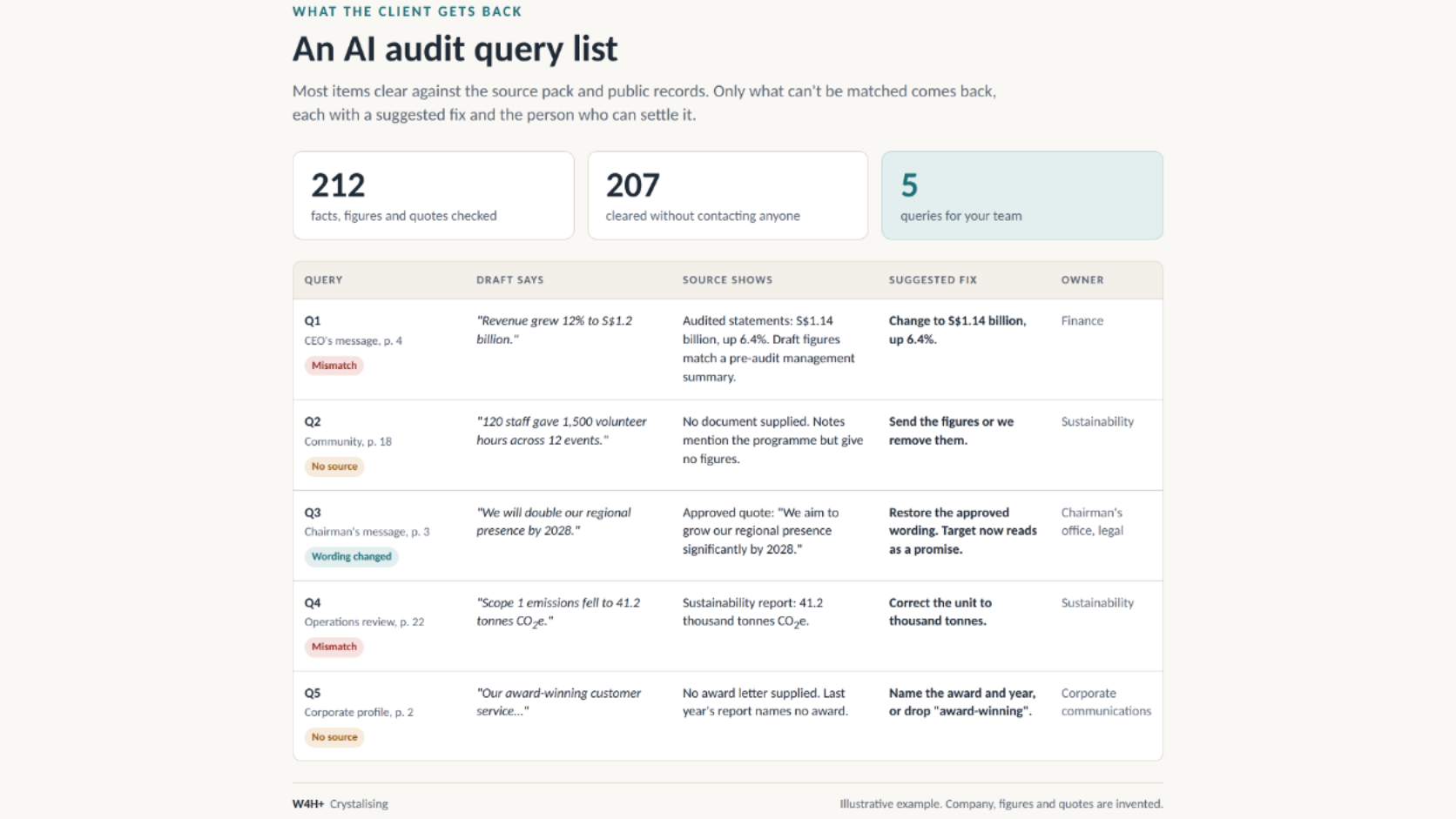
What you get is a short list. A table with one row per query, each stating where the problem is, what the draft says, what the source shows and the discrepancy to be settled.
Where AI helps and where it can slip
LLMs work best on tasks where the material already exists and the task is repetitive. Here are five jobs machines can do in the annual report drafting process. But each still carries a risk.
- Interview notes: Transcribing management interviews and pulling out the main points for the writer.
Risk: It can mishear names, numbers and industry terms. A summary can also drop a caveat or give weight to a passing remark. - First drafts: Producing a first draft of factual sections, such as the corporate profile or operations review, from material the company has already approved.
Risk: It can mix up this year’s and last year’s figures, carry over facts that are out of date or add details that were never in the material. - Cross checks: Comparing the annual report with the sustainability report to catch figures and claims that don’t match.
Risk: It can miss mismatches, especially where units or reporting periods differ. A clean result does not mean the two reports agree. - Plain English: Turning dense technical or financial passages into plain English.
Risk: Simplifying can shift the meaning, drop a qualifier such as “subject to approval” or turn a target into a promise. - House Style: Checking the draft against your corporate editorial convention and usage guidelines.
Risk: It can still apply rules unevenly across a long document and “correct” official names, defined terms or quotes that should stay as they are.
The risk are higher when AI is asked to fill gaps.
Say the sustainability team sends notes on a staff volunteering programme with a charity in Toa Payoh, but no figures. Someone asks an AI tool to flesh out the paragraph. It comes back saying 120 staff gave 1,500 hours across 12 events. The paragraph reads beautifully. The sustainability team would be delighted, if any of it had happened.
Asked to complete a paragraph, the AI wrote what a paragraph like that typically contains. LLMs are built to produce text that sounds likely, not to look up facts. They are also trained much as we were taught to sit exams, where a guess might earn marks and a blank earns none. They rarely say when they don’t know.
Keeping people in command
Reports have a clear chain of sign-off. The Chairman approves the Chairman’s message, the CFO approves the numbers and the company secretary approves the governance statements.
What often has no clear shape is the working team underneath, the people who make sure what reaches those signatories is right.
You will hear people talk about keeping a human in the loop. That puts a person at the end, checking what the machine produced. In command puts people ahead of it as well, deciding what AI is used for and setting the rules before any drafting starts
The workflow we use:
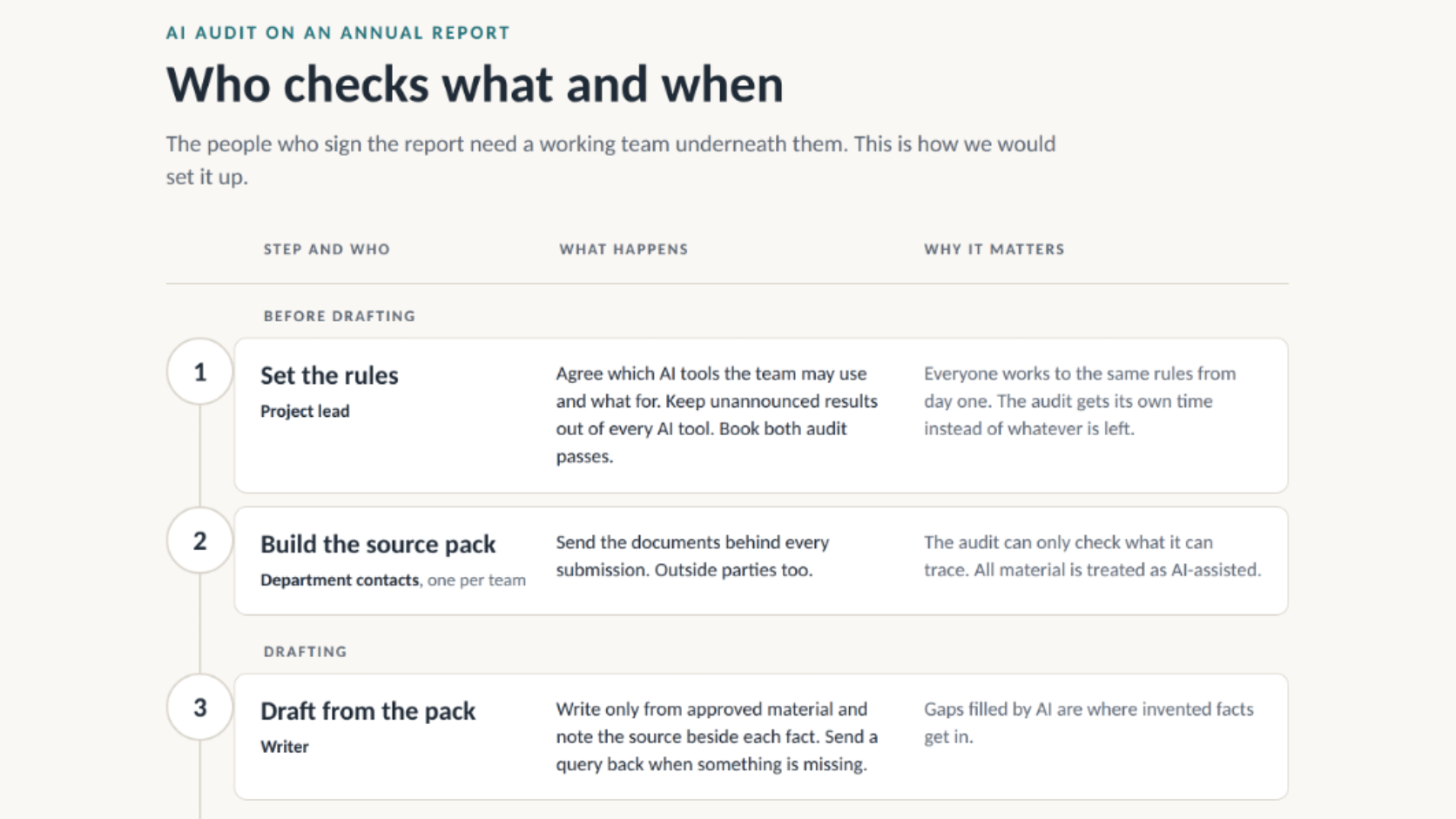
- Set the rules. Project lead. Before anyone drafts, agree which AI tools the team may use and what for. Business versions that don’t keep or learn from what is typed into them are the safer choice. Unannounced results and other price-sensitive information stay out of every AI tool. Book both audit passes into the schedule now, before the deadline quietly eats them.
- Build the source pack. Department contacts. Each contributing team, and any outside party, names one person. That person sends the documents behind every submission, such as the board paper behind a figure, the approved quote or the award letter. The audit can only check what it can trace.
- Draft from the pack. Writer. The writer works from the source pack and notes the source beside each fact. When something is missing, a query goes back to the department. Gaps are not filled with something that sounds about right.
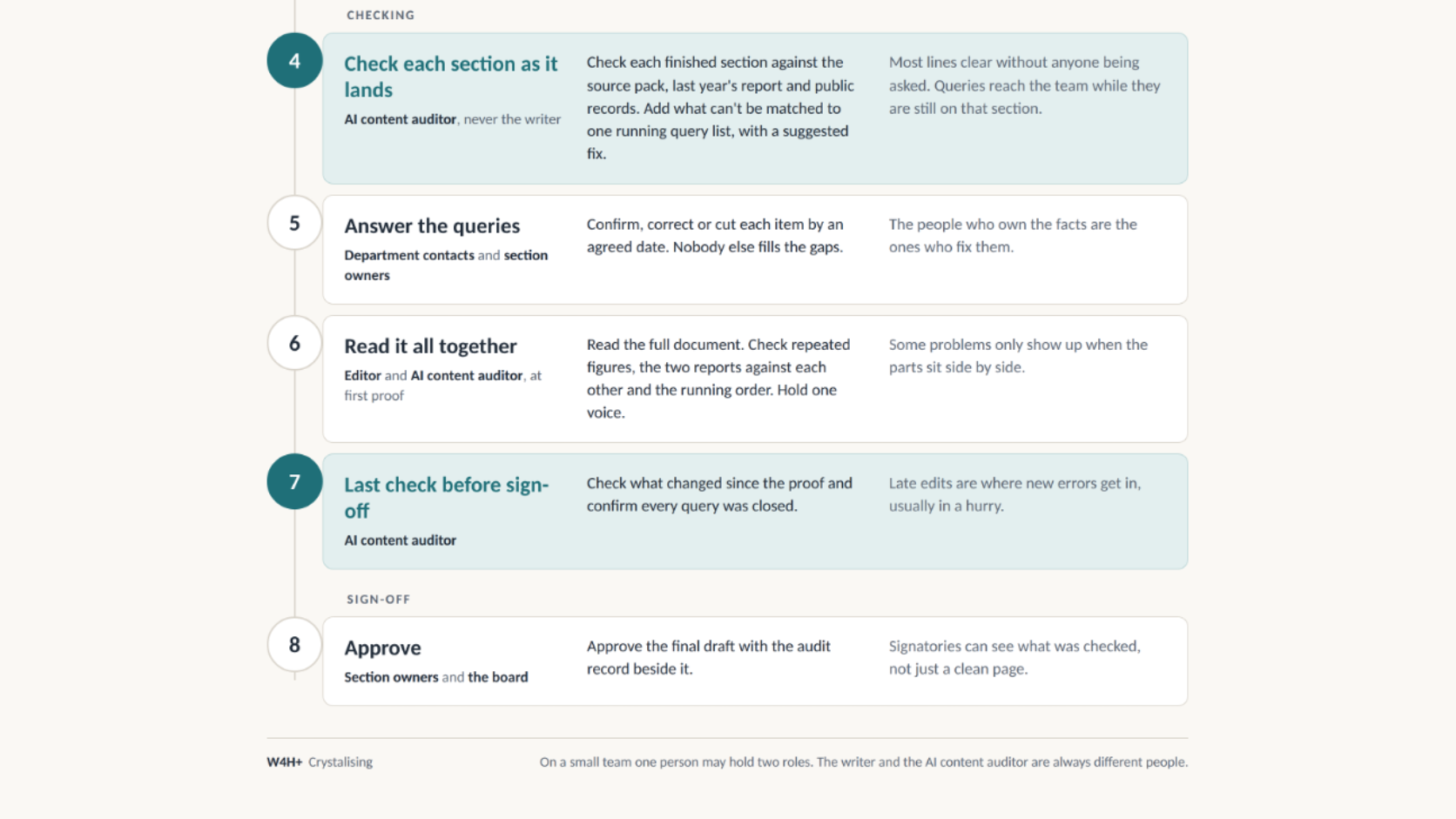
- Check each section as it lands. AI content auditor. No need to wait for the whole report. When a section is done and its owner is happy with it, it gets checked against the source pack, last year’s report, the sustainability report and public records. What can’t be matched goes on one running query list for the whole report, each item with a suggested fix.
- Answer the queries while the section is still warm. Department contacts and section owners. The people who own the facts confirm, correct or cut.
- First proof. Editor and AI content auditor. Some things only show up once the parts sit side by side, such as the same figure quoted three ways, the annual report saying one thing and the sustainability report another.
- Final check before sign-off. AI content auditor. Only what changed since the proof, plus a run down the query list to make sure everything was closed. Late edits are where new errors get in, usually in a hurry.
On a small team one person may hold two of these roles. The writer and the AI auditor should always be different people.
On a small team one person may hold two of these roles. The writer and the AI auditor should always be different people.
What an AI audit checks
At each pass, the auditor works through the following.
Sources. Every fact, figure and quote matches a document the company supplied or a public record. A figure from a board paper is matched to the final version of that paper, not an earlier draft that did the rounds.
Numbers. Figures in the narrative match the audited financial statements and the sustainability report. That includes rounding, units and the period each figure covers.
Invented material. Any reference, case study, statistic or award with no document behind it goes on the query list.
Quotes. Each quote matches the wording its speaker approved. An AI asked to polish a section will polish the quotes inside it too, so the two versions are compared line by line.
Voice. Leadership messages sound like the people who signed them. The report doesn’t change personality from one section to the next.
Forward-looking statements. Anything about targets, outlook or plans has been seen by its owner and by whoever handles legal or investor relations review.
A full query list might look like this.
An example
This example is illustrative. A CEO’s message drafted with AI help says revenue grew 12% to S$1.2 billion. The audited financial statements show S$1.14 billion, up 6.4%. The draft had been built from a management summary circulated before the audit adjustments. The AI had no way of knowing the numbers had changed. It used what it was given and wrote the sentence well enough that nobody questioned it.
Correcting it takes minutes once someone spots it. That only happens if every figure in the message is checked against the final statements, including the ones that look right.
Who should run it
On an in-house team the AI auditor could be a colleague from another department. An outside writer or editor can also take it on, bringing a fresh read and no attachment to how any section was worded. Either way, the AI auditor checks and flags while the content owner decides.
The final call on whether something is right still needs a person, because the tools that produce these errors can’t be relied on to catch them.
The final read
Once the queries are closed, the report still needs one read as a reader, not as a checker.
Does the report tell one story, or does each department tell its own? Does the Chairman’s message answer what shareholders are actually asking this year? Do the highlights, charts and captions carry the same weight as the narrative, or does a good year hide in a footnote while a small win takes a full page? Is the tone right for the year the company has had?
Then the small things. Jargon that means nothing outside the industry. A section that runs long because someone had more to say, not because the reader needs it. A caption that repeats the chart instead of explaining it. A paragraph written to fill a page.
The final read is what makes it sound like one company talking.
Starting this year’s report
If AI is part of this year’s report, tell us what you’re working on. We can help you set up the AI audit or run it alongside your team.
Sources


