
Crystallising...
Creative Fuel
Creativity takes some stubbornness.
By Crystal Song
Aug 24, 2026
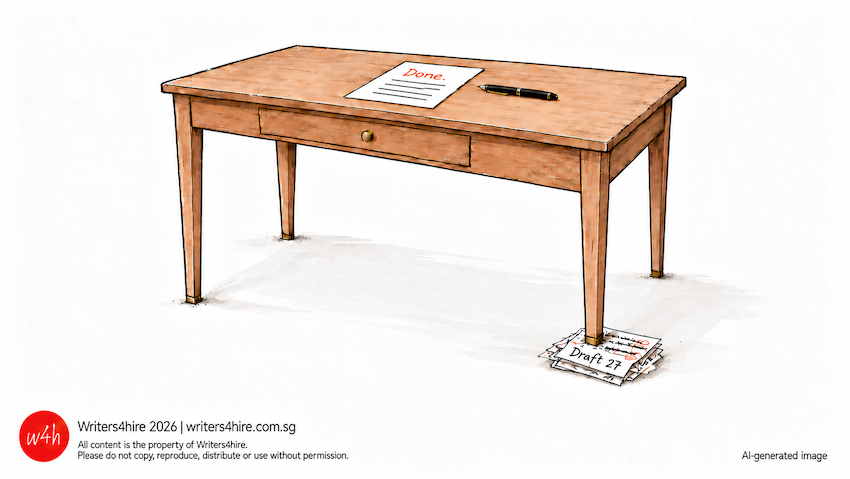
I often hear people say, “I’m not the creative type.”
Often, they mean that they don’t have an affinity for drawing, or writing, playing an instrument or perhaps never felt the urge to take up pottery.
Somewhere along the way, the arts have taken ownership of the word ‘creative’. It’s become something you are either born with or have to manage without.
But we all know it’s more than that. How about that colleague who manages to order a lunch everyone likes even when half the team says “anything also can”? Or the parent who could calm a tot’s terrible-twos tantrum on the hottest day in the busiest mall? Or the first person who decided that a pack of tissue on the table could reserve a seat in a crowded foodcourt (only works in Singapore). Doesn’t our demanding daily grind take a lot of creativity?
What is creativity, anyway?
Researchers Mark Runco and Garrett Jaeger set out two requirements for creativity: originality and effectiveness. An idea needs to offer something new and work in its context1.
A joke, for instance, is created to make someone laugh. An ad gives someone a reason to act.
New, by itself, may just mean being different. Turn your CV into a crossword and you have achieved novelty. But i am not sure how useful that idea will be in actually getting you in for an interview, much less the job, which is presumably your goal.
The creative challenge is to find a fresh approach that does the intended job well. And sometimes, even when it does, you want to see what else is possible.
Wanting more from your work
Boxing legend Muhammad Ali said champions “have to have the skill, and the will. But the will must be stronger than the skill” 2.
Creative work is much the same. It often asks more of you than you know how to do yet. Wanting to do it well gives you a reason to learn. That’s the useful kind of stubbornness that comes from having your own hopes for the work, not from our client, boss or parents pushing you.
The moment you want to give up
Most brainstorms follow the same pattern. The first few ideas come easily. Then things start to slow down and the room becomes much quieter. Just as the silence becomes awkward, someone suggests that one of the earlier just-okay ideas may be the best we can settle for.
It’s tempting to take the lull as a sign that you’ve run out of ideas.
Researchers Brian Lucas and Loran Nordgren call this the “creative cliff illusion”. They found that people tend to expect their ideas to be less creative the longer a brainstorm session goes on. They also found that what actually happens is that creative performance often holds steady or improves3.
The ideas may come more slowly but it doesn’t mean they will not be better.
So, just at the point when you’re about to throw in the towel, keep on going. If you keep circling the same types of answers, take a break and return to it.
Of course, I am not suggesting that we should turn every task into an endurance event. Editing my own work has taught me that knowing when to stop is also part of the skill. Once the idea does the job well, you can leave it be. But the first time you get stuck doesn’t mean you’ve run out of ideas. Just be careful about treating the first difficult moments as evidence that you won’t be able to come up with a better way.
Stubbornness is easier when you care
What do you enjoy doing even if you’re not paid for it?
Perhaps it’s baking, or like me, cooking. You experiment with a recipe, adjust the ingredients and relish watching your loved ones enjoy your creations. Those that are successful anyways. And you can’t wait for something new next time.
Your interests gives your creativity plenty to work with. You notice more and willingly spend time getting better.
Of course, it’s hard to feel that way about everything. A monthly report is unlikely to inspire the same affection over time. Sometimes, though, the interest comes back when you dig a little deeper or find a new reason to care. Perhaps you learn that your boss reads it before every board meeting. Or you try a new AI tool and realise those numbers could finally be a chart people understand.
I used to think long-form writing was boring. I’ve written white papers and corporate reports for plastic pellet manufacturers, oilfield safety businesses and developers of marine cargo fleet optimisation software. Not subjects that immediately make you cancel your dinner plans.
But the more I read, the more I understood. Entire exciting worlds opened up to me. I’ve always believed that even the dullest subject has a story, one people would want to hear if it were told in a way that mattered to them. I’ve never accepted that there’s no way to tell it. There’s always a way and I’ll find it. It just takes a little stubbornness.
The crow and the pitcher
You’ve probably heard Aesop’s fable about the thirsty crow.
It was a hot day and the crow had been flying for hours. It found a pitcher with a little water at the bottom. First, it stuck its beak in. Too short. Then it pushed its head in further. Still too short. Frustrated, it leaned hard on the pitcher, trying to tip it over. But the pitcher wouldn’t budge, too heavy for the crow. Even more agitated, the crow pecked at the side of the pitcher to try to crack it open. Nothing happened. Determined, the crow stepped away to take a break.
Then it noticed some pebbles lying nearby. First, it picked one up and dropped it in. The water level rose. So, it picked up another and did the same. And another. Gradually the water rose until the crow could finally drink.
For a long time, that was just a story for children. In 2009, two Cambridge researchers decided to find out whether a real bird could do it. They gave rooks, cousins of the crow, a tube with a little water and a worm floating out of reach. The rooks dropped stones in until the worm floated up3. Some of them even chose bigger stones, which did the job faster.
Aesop’s tale, it turns out, was fact, not fable. The crow didn’t solve the problem on its first or fourth try. But its stubborn persistence finally paid off.
Most of the creative people I know aren’t more gifted than anyone else. They just stay with a problem a little longer than is comfortable and want the work to be just a little better than it needs to be. That stubbornness is not reserved for artists.
We should be stubborn everyday, especially when we’ve racked our brains and still haven’t found the right ideas. The best one is very likely just around the corner.
If you have an idea you want to discuss or one you need our help with, drop me a line
.


