
Crystallising...
Creative Fuel
"Make it pop!" Eight ways to find fresh ideas.
By Crystal Song
Oct 12, 2026
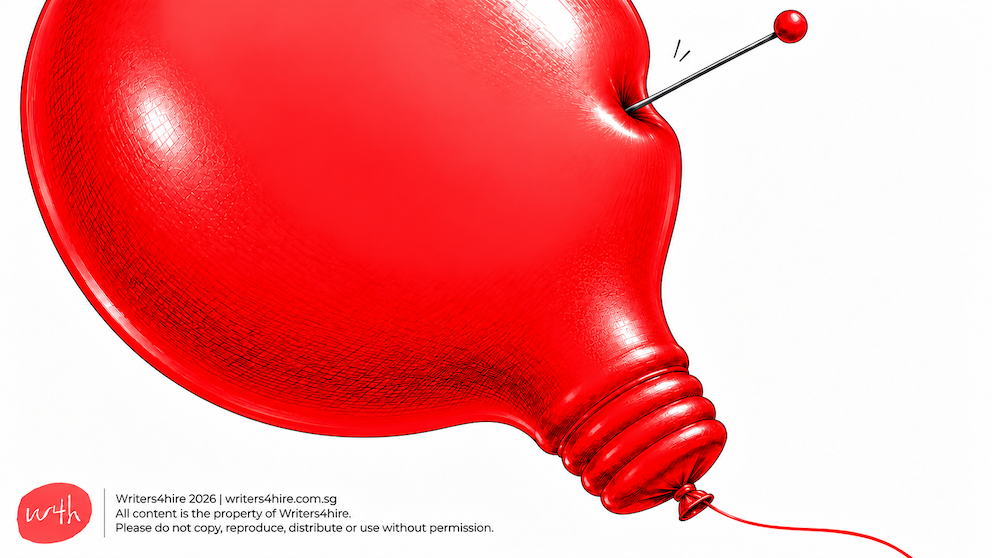
“Be more creative.” “Give it some oomph.” “Can we refresh this?”
If you write for a living, you’ve heard all three. Face it, sometimes the feedback is fair. The draft does the job, but there’s nothing in it that makes you want to read on.
You can spend another hour changing the headline. But if the thinking underneath stays the same, you end up with nothing more than a better-dressed version of what you already had.
Here are eight techniques I use that might get you out of the doldrums of tried and tired ideas.
1. Find out what “more creative” means
Before you rewrite anything, ask the person who wants to change what feels missing. Is the benefit hard to see ? Does the copy not touch on what the reader cares about?
These examples show different problems, and they need different fixes.
We recently wrote an invitation to a sourdough baking workshop. Sign-ups were slow, and we learned from the client that people thought the workshop would be too advanced for their skill level. It didn’t help that the workshop had words like “Masterclass” and “artisan” in it, which may signal to beginners that this is not for them.
In this case, a livelier headline won’t change that. What might is showing them the first thing they’ll do:. So we opened with a line that invited newbies in:
Beginners make the best starters. No experience needed.
If we had just tweaked the client’s original ad headline to be more energetic, you might not have fixed the problem, which really was about making the beginner bakers feel they belong. Sign-ups increased by over 20%.
So before you write a word, try finishing this sentence:
The reader thinks ______. We need to help them see ______.
For the sourdough workshop, it read: The reader thinks this class is for experienced bakers. We need to help them see it was made for beginners.
Once that’s filled in, you know what you’re aiming at.
2. See things from the reader’s eyes
A company is excited about its new system. But an employee, who is the reader of the copy, is wondering how long it will take to learn.
By putting those two thoughts next to each other, you have your way into the story.
Rather than lead with features, you might show what happens to a familiar task: six steps become two, or the same information no longer needs to be entered three times. You’ll need to check the facts, but now you know which facts to ask for.
Write down the question the reader might ask privately. “Will this make my day easier?” or “Why does this cost more?” or “Is this class too advanced for me?”
Answer the questions first before any writing begins.
3. Make the claim visible
“Convenient.” “Reliable.” “Personalised.” These words tell readers what to think but very little for them to picture.
What would we actually see if the claim were true?
For a service described as convenient, perhaps a customer can complete the task on their phone without needing a printer. For a product designed for small homes, perhaps it fits into the tiny real estate beside the fridge.
Ask the client what would show the benefit. A demonstration or a comparison? You may discover that the most interesting thing is sitting halfway down the list of product features.
4. Start with the objection
We tend to organise copy around reasons to say yes. Sometimes it’s more useful to start with the reason people say no.
“It costs more.”
“I already have something that does this.”
“I don’t have time to learn another system.”
Choose the strongest genuine objection and build your idea around answering it. If a product costs more because it can be repaired, show what can be replaced and how. If switching systems takes work, say how much work and why it’s worth it.
The objection keeps you from writing an enthusiastic answer that perhaps no one has asked.
5. Stop making the expected thing
When I brief a junior writer on a brochure, I often add a request. Don’t write me something that looks like a brochure.
All the necessary information still needs to be in it but the draft should not automatically begin with “About us”
Could we follow the product through one working day? Help the reader choose between three situations? Answer the awkward question that stops them from buying? If discovery is part of the appeal, could the brochure look like a blind box?
Before writing any copy, sketch out three possible directions. Each will lead you to different material.
6. Take away your usual tools
Sometimes it helps to ban the most obvious approach for a while.
Describe the product without using its category name. Convey quality without using the words “quality”, “premium” or “excellence”. Introduce the company without its founding date or list of services.
This is an exercise, not a rule for the finished copy. You can put the words back later, of course.
For now, the ban makes you find something else to say. What does the product enable? What makes the workmanship good? What would someone notice about this company after working with it?
If removing one familiar phrase leaves us with nothing, that says something too. You need to get our hands on better material and the client probably has it.
7. Look somewhere completely unrelated
When I’m stuck, I flip through magazines and study ads for all sorts of products. Sometimes I do the doomscroll oor even watch the Kardashians and call it research.
The question i’m asking is: what is this doing that I could try with my subject?
An ad might show a product’s benefit by showing life without it. A story might start with an unexpected outcome and work backwards to how it happened. You never know what your brain might connect, even from something totally unrelated to the draft.
Reference material from the same industry can be helpful too. Mostly, I use it to see what not to do.
Sometimes looking elsewhere is just a break. I come back less stuck on the same few thoughts that keep me going in circles.
8. Separate the idea from the wording
Before polishing, describe each approach in one plain sentence.
“We show how the product fits into a small flat.”
“We explain why it costs more by showing the parts that can be repaired.”
“We let readers choose their situation and find the option that suits them.”
Now you can see whether you have three different ideas or one idea with three different headlines.
It also means you can discuss your directions with the client or your account manager before spending hours making every sentence lovely. If the approach is wrong, the loveliest sentence won’t save it.
You don’t need to try all of these on every job. Pick the one that challenges what you’ve already done. There are more than 8 ways to get more creative, of course. These are the ones I usually turn to. Drop me a line and tell me yours.


