
Crystallising...
Creative Fuel, Learn with Me
Think sideways: a few old tricks for coming up with new ideas.
Nov 7, 2026
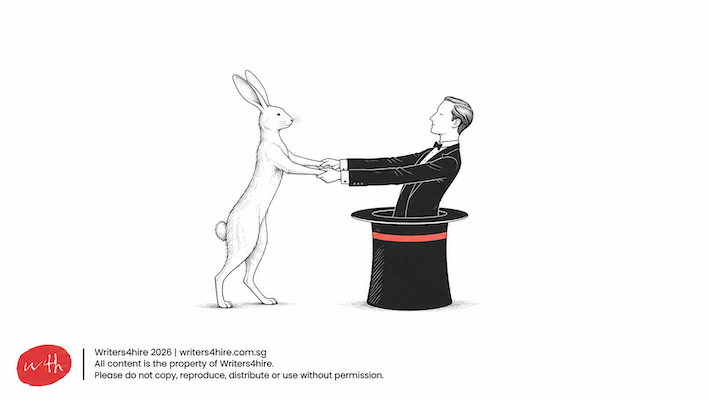
Copywriting taught me lateral thinking, something my education, right up to university, never did.
It taught me to look beyond the obvious, see from varying viewpoints, link facts in ways that make a message memorable, and find stories that help people see a situation differently.
As a copywriter, thinking laterally to come up with fresh ideas every day has made playtime of work. And it inevitably spills into everyday life whether it is unclogging a drain or fixing dinner for last-minute guests. So yes, it’s learnable and requires practice.
This famous story demonstrates lateral thinking.
A shopkeeper owed a moneylender a lot of money. The moneylender said he would cancel the debt if he could marry the shopkeeper’s daughter. Neither father nor daughter wanted that, so the moneylender suggested they leave it to luck. He would put one black pebble and one white pebble in a bag, and the daughter would pick one without looking. If she picked black, she would have to marry the moneylender. If she picked white, she wouldn’t have to. Either way, the debt would be cancelled.
They were standing on a path covered in pebbles. The moneylender bent down, picked up two and put them in the bag. The daughter saw that both were black.
She could refuse to pick, but then her father would go to jail. She could show everyone that both pebbles were black, but her father would still owe the money. Or she could just pick and marry the moneylender.
She saw another option. She took a pebble out of the bag and dropped it on the path before anyone saw its colour. The pebble was lost among the others. Then she said they could tell which one she picked by looking at the one still in the bag. That one was black, so hers must have been white. The moneylender couldn’t argue without admitting he cheated.
Edward de Bono, a doctor from Malta, opened his first book on the subject, The Use of Lateral Thinking, with this story in 1967.1 He invented the term.2 His publisher, Penguin, says his name became a symbol of creativity and new thinking for millions of people worldwide.2 Three years later he wrote a practical follow-up, Lateral Thinking: Creativity Step by Step.De Bono spent the rest of his life telling people that new ideas don’t depend on talent.
You can practise getting them by activating your lateral thinking brain.
I was reading the follow-up the other day and one thing kept coming back to me. We now have tools that will give us as many ideas as we ask for. Many of them are very good.
In 2023, Wharton professors gave GPT-4 the same brief they give their students: come up with a new product that could sell for US$50 or less. People in the target market then rated how likely they were to buy each one. The AI’s ideas scored higher on average. Of the 40 best ideas, 35 came from the AI.3
So AI can come up with ideas that buyers like, but there’s a catch.
When Wharton researchers looked at the whole pile, GPT-4’s ideas were less varied than ideas from groups of people.4 In later experiments, ideas produced with ChatGPT were significantly less varied in 37 of 45 comparisons.5
AI can come up with good ideas, but they tend to be alike.
Chatbots work this way by design. A chatbot builds its answer from what is most likely to come next, so the same question tends to bring back similar answers. If your competitors use the same tools as you do, chances are the best idea you come up with will look a lot like the best idea in theirs.
De Bono had a name for this kind of thinking long before ChatGPT. He called it vertical thinking. It follows the most likely path, one correct step at a time. That is what you want when there is a right answer to be found, such as checking the consistency of terms or figures in a report. It’s less useful when you need to generate ideas that won’t be similar to someone else’s.
Lateral thinking looks for other ways to see a problem. And you can get better at it with practice.
You could read the book yourself. Some of it shows its age, so I thought it would be useful to pick the techniques I think still work today. I’ve also added my thoughts on how you can use AI to push your thinking further sideways.
Vertical vs Lateral Thinking
De Bono said we need both kinds of thinking. We use lateral thinking to come up with more ideas and vertical thinking to pick one and check that it works.2
Here are the key differences between vertical and lateral thinking:
| Vertical thinking | Lateral thinking |
|---|---|
| Selective Picks the best idea |
Generative Looks for more ideas |
| Directed Moves only when it knows where it’s going |
Exploratory Moves to find a direction |
| Sequential Goes one step at a time |
Leaping Can jump ahead and fill the gap later |
| Rightness Has to be right at every step |
Richness Can be wrong along the way |
| Judging Says no early to rule things out |
Open Holds off saying no |
| Focused Shuts out anything that seems irrelevant |
Receptive Welcomes chance interruptions |
| Likely Follows the most likely path |
Unlikely Tries the least likely path |
| Certain Promises an answer |
Hopeful Raises the chance of a better answer with no promise |
Most of us learned the left column first. At school, there was usually one right answer. You lost marks if you didn’t show your working. At work, it could be a work template, last year’s report for reference and the chain of approval. Chatbots or Large Language Models (LLMs) like ChatGPT and Claude work the same way. They build each answer by predicting the next likely word.
The right column needs practice. We all know someone in our lives (maybe it’s you) who is always so quick with replies that they make everyone laugh out loud. De Bono saw humour and jokes as lateral thinking in action. The joke leads you down the obvious path, then switches to one you didn’t see coming. The laugh comes when you see both at once.6
A manager asks the team to cut the annual report down to 50 pages. They hand it back at 50 pages, in a smaller font. You expected them to cut words. They thought sideways. Shareholders just need to whip out their magnifying glasses.
A few weeks ago I wrote Creativity takes some stubbornness, about keeping going when the ideas slow down. Reading de Bono, I found I’d been naturally using some of his methods unknowingly. Each of the seven techniques below is based on a chapter in de Bono’s Lateral Thinking: Creativity Step by Step. I’ve given some of them plainer names with examples and my suggested AI prompts for each one.
Get more ideas than you need
1. Set a quota
Before you start, decide how many ideas you want. Don’t stop until you have them because we tend to stop once we hit the first great idea.
Try this
Write down four ways to describe your problem. “Nobody reads our newsletter” could mean it’s too long, sent at the wrong time, not trusted or not wanted. Each one points to a different fix.
With AI
Write your four problem descriptions first. Then ask: “Give me four more ways to describe this problem, different from mine.”
2. Bring in a random word
Pick a word that has nothing to do with your problem and find a link. It pulls your thinking off its usual track.
Try this
Open any book and take the first noun you see. Write down three things about it. Link each one to your problem. Say the problem is a boring town hall and the word is durian. Durians are banned on the MRT. So ban something from your town hall too. Slides with more than 20 words would be a good start. Throw forth the idea and see whether it sticks or sinks.
With AI
Ask about how random things work together, e.g., a business: “How would a hawker stall, an airline and a theme park each solve this problem?” AI knows a lot about how different businesses work, so it can bring in ideas from well outside your field. Assess the findings to see if there are any links that might work.
Question the problem before you solve it
3. Ask why, then ask again
Pick something your team does every time without thinking about it. Then find out whether there’s a good reason for it, or whether it’s just habit.
Try this
Pick one thing your team always does and ask why three times. “Why does our annual report open with the Chairman’s message?” Because it always has. “Why?” Because readers expect it. “Why do they expect it?” It’s worth checking with a few readers.
With AI
Ask: “Give me examples of companies that open their annual report with something other than the Chairman’s message.” Then check that the examples are real and get some ideas of how they approach their opening.
Approach it from another side
4. Turn it around
Take the usual way something is done and do the opposite. An annual report usually opens with the company talking to shareholders. Turn it around and let shareholders speak first. Open with three questions they asked at the last AGM. De Bono called this the reversal method. Most results may sound silly, but they often lead to a better idea.
Try this
Instead of chasing departments for content, ask each one: “What’s the one question you wish readers would ask about your work this year?” You might get a sharper story than a page of updates.
With AI
Paste last year’s contents page and ask: “What would this report look like if our shareholders had written the contents page?” It takes a minute, and you may see the report the way readers do.
5. Start somewhere else
Where you start shapes where you end up. Most of us start in the same place every time.
Try this
Start a sustainability report from what a frontline worker sees every day. Start a company profile from the complaint customers make most often.
With AI
Paste a short summary of your year and ask: “Write the opening paragraph of our sustainability report for an investor deciding whether to buy our shares.” Compare with how your report opens now.
6. Break it into pieces
De Bono called this fractionation. Split the problem into its parts, then examine if there are any parts that can change.
Try this
A staff newsletter has a writer, a schedule, a length and a place where it’s read. Change the writer, and frontline teams could take turns writing it instead of the communications team. Change the place where it’s read and it could become a more visual one-pager to be read while waiting for the bus.
With AI
Ask: “List everything that goes into our staff newsletter, from who writes and approves it to when it goes out and where people read it.” Sometimes the parts that make a difference are the ones that no one ever thought of looking at. Pick one you hadn’t considered and try changing just that.
Hold off saying no
7. Use the word PO
De Bono made up the word PO, which sits between YES and NO. Use it to say something impossible on purpose, then see where it leads.
Try this
“PO, the annual report has no words.” That wouldn’t work but it does make you think about what charts and pictures can carry better than paragraphs. You may end up with a stronger highlights section.
With AI
Ask: “Argue seriously for this idea: our annual report has no words.” Remember to practise holding off saying no!
Practise on small things
The shopkeeper’s daughter had a few seconds on a pebble path. Most of us get far more time than that and still take the most obvious path in front of us. Practise on small things, like a meeting that always runs late or a template that people keep filling in wrongly. Before you know it, you’ll be a pro at lateral thinking when something bigger comes along.
I hope you give a few of these a try. Drop me a line to tell me how it all went.
Sources
- de Bono, E. (1967). The Use of Lateral Thinking. De Bono’s own note that the pebble story opened his first book: debono.com
- Penguin, Lateral Thinking by Edward de Bono (book page)
- Girotra, K., Meincke, L., Terwiesch, C. and Ulrich, K. (2023). Ideas Are Dimes a Dozen: Large Language Models for Idea Generation in Innovation. Wharton School working paper.
- Meincke, L., Mollick, E. and Terwiesch, C. (2024). Prompting Diverse Ideas: Increasing AI Idea Variance. Wharton School working paper.
- Knowledge at Wharton, on ChatGPT and idea diversity in brainstorming
- The Irish Times (2021). Edward de Bono obituary


